
Are drop sets better for building muscle, or are they simply another way to make your workouts feel harder? Discover how they work and when personal trainers should use them.
You’ve probably seen someone finish a set of dumbbell curls, immediately grab a lighter pair and carry on until their arms are burning.
That’s a drop set.
But does making an exercise feel harder automatically make it more effective?
Not necessarily.
Drop sets are a popular resistance training method, particularly for muscle growth. However, understanding when and why to use them is more important than simply adding them to every workout.
What Are Drop Sets?
A drop set involves completing an exercise, reducing the resistance and continuing with additional repetitions, usually with little or no rest.
For example, after completing a challenging set of biceps curls, you immediately select lighter dumbbells and continue exercising.
You can perform a single drop or several consecutive reductions in resistance.
The initial set is often performed close to muscular failure, although reaching complete failure isn’t compulsory.
The purpose is to extend the set by allowing additional repetitions as fatigue accumulates.
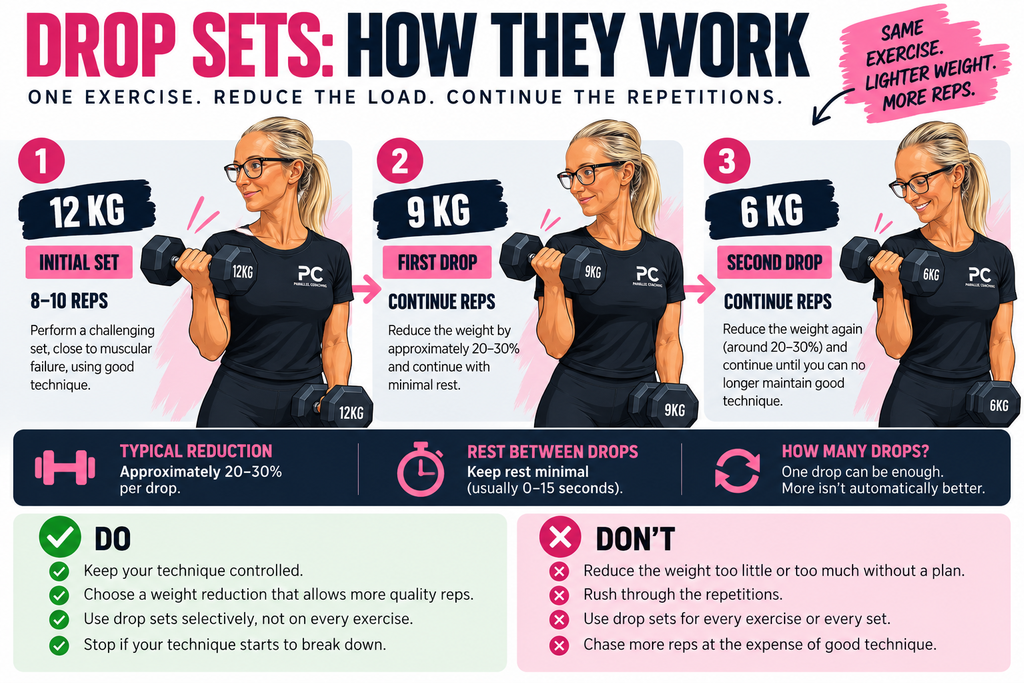
Infographic: Dumbbell biceps curl example showing 12 kg → 9 kg → 6 kg, approximately 20–30% load reductions, minimal rest and controlled repetitions. Explain that these are illustrative starting points, not fixed rules.
Why Do Drop Sets Work?
As a muscle becomes fatigued, it becomes increasingly difficult to continue lifting the same resistance.
Reducing the load allows additional repetitions, extending the muscular work performed.
This can provide further opportunities to generate mechanical tension, an important stimulus for muscle hypertrophy.
As fatigue increases, the nervous system may recruit additional motor units to maintain the required force, although recruitment depends on the load and effort involved.
Drop sets can also create considerable metabolic stress and the familiar burning sensation.
However, more burning doesn’t automatically mean more muscle growth.
The important consideration is whether the additional repetitions provide a useful training stimulus without creating excessive fatigue.
Are Drop Sets Better Than Traditional Sets?
Research generally suggests that drop sets can produce similar muscle growth to traditional resistance training when appropriately programmed.
Their main advantage is often time efficiency.
Traditional sets usually include planned rest periods, allowing greater recovery before the next set.
Drop sets reduce that recovery time, allowing additional work to be completed relatively quickly.
However, this also creates considerable local muscular fatigue, which may affect performance in subsequent exercises.
For maximal strength development, traditional sets with sufficient recovery are generally more appropriate because they allow higher loads and better repetition quality.
Time-efficient doesn’t automatically mean more effective.
The best choice depends on the client’s goal, experience, available time and ability to recover.
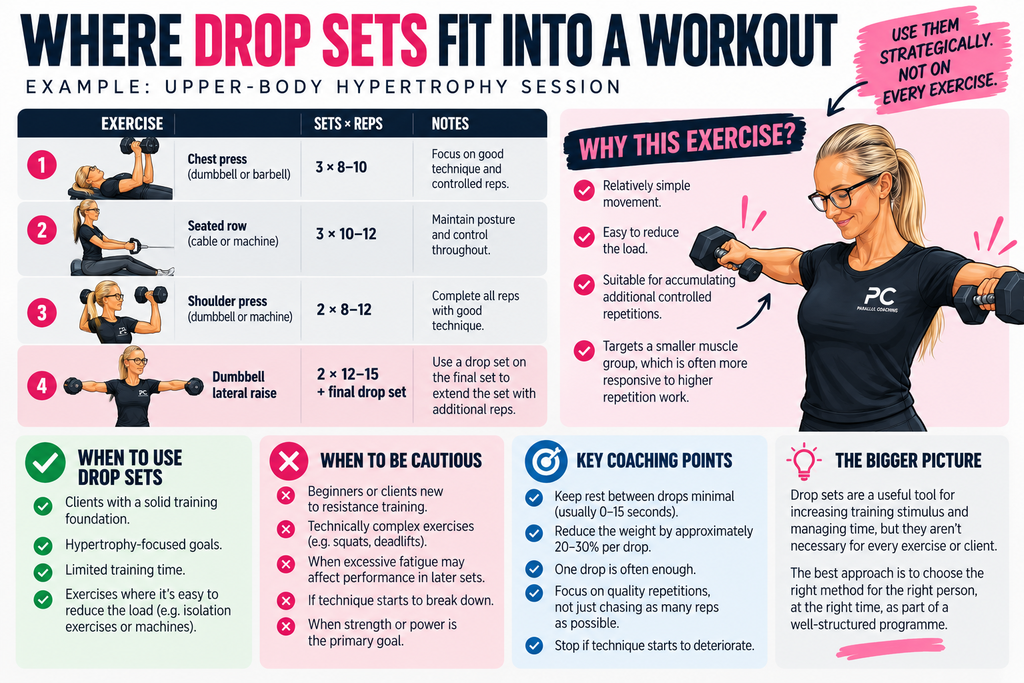
Infographic: Upper-body hypertrophy session featuring chest press 3 × 8–10, seated row 3 × 10–12, shoulder press 2 × 8–12 and dumbbell lateral raises 2 × 12–15, with a single drop added to the final lateral raise set. Include why this exercise was selected and when to consider or avoid drop sets.
When Should Personal Trainers Use Drop Sets?
Drop sets can be useful for clients with an established resistance training foundation who want to increase their hypertrophy-focused training stimulus or make efficient use of limited training time.
They’re often practical with exercises such as lateral raises, biceps curls or machine-based movements, where reducing resistance is straightforward.
However, adding them to technically demanding exercises may create unnecessary challenges as fatigue increases.
Exercise selection matters just as much as the training method.
It’s also important to distinguish between two types of failure.
Momentary muscular failure occurs when someone cannot complete another repetition despite attempting to maintain the intended technique.
Technical failure occurs when they can no longer maintain acceptable movement quality or control.
Reaching muscular failure isn’t essential for every drop set, and continuing once technique becomes unacceptable shouldn’t be the objective.
Four Common Drop-Set Mistakes
1. Reducing the weight without a purpose. A reduction of approximately 20–30% can be a practical starting point, but the appropriate adjustment depends on the exercise, individual and desired repetitions.
2. Chasing repetitions at the expense of technique. More repetitions aren’t automatically beneficial if movement quality deteriorates.
3. Adding drop sets to every exercise. One well-placed drop set may be sufficient. Multiple drops and repeated use can accumulate unnecessary fatigue.
4. Confusing exhaustion with progress. Muscle soreness, burning and fatigue don’t prove that a session was more effective.
Are Drop Sets a Form of Progressive Overload?
Not automatically.
Drop sets describe how a set is organised, whereas progressive overload involves increasing training demands appropriately over time.
A drop set may contribute to a programme’s overall training stimulus, but simply adding one doesn’t guarantee progressive overload or improved results.
Progress still depends on appropriate programming, recovery and how the client adapts over time.
The Coach’s Takeaway
Drop sets are a tool. Not a personality trait.
They’re one option for creating a hypertrophy stimulus, managing training time and adding variety.
But great coaching isn’t about making every session harder.
It’s about choosing the right training method for the right person, at the right time.
Ready to Take Your Coaching Beyond the Textbook?
Understanding what a drop set is forms part of your exercise knowledge.
Knowing when, why and how to apply it with a real client is where your coaching develops.
That’s exactly the kind of practical decision-making we focus on at Parallel Coaching.
Discover our FITPRO Ready to Coach training and build the confidence to turn exercise knowledge into effective coaching.
https://courses.parallelcoaching.co.uk/products/fitpro-ready-to-coach
Dedicated to More
Hayley “Drop Sets Explained” Bergman
Parallel Coaching
P.S. You can also find us on the following platforms:
Instagram: Follow Parallel Coaching on Instagram
Facebook: Follow us on Facebook
YouTube: Watch our YouTube tutorials
More Blogs: Explore our Training Systems blogs
Trustpilot: Read our learner reviews