
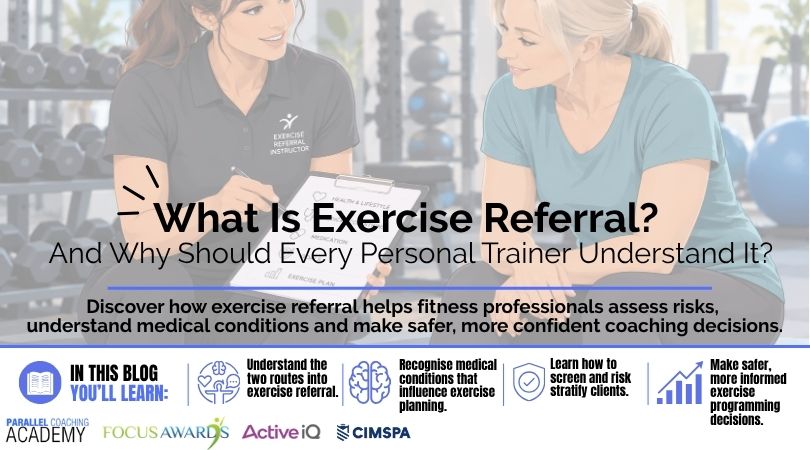
You know how to plan an exercise programme.
But what happens when a client discloses a medical condition on their PAR-Q?
They want to exercise. You want to help. But how do you know what’s appropriate?
That’s where Level 3 Exercise Referral knowledge becomes invaluable.
What Is Exercise Referral?
There are two important ways fitness professionals encounter clients with medical conditions.
1. Formal healthcare referrals
A healthcare professional refers an eligible individual into an exercise referral programme, where a suitably qualified instructor assesses their needs, delivers appropriate exercise and monitors progress.
2. Clients approaching you directly
You might work in a gym, home, park or private studio.
A new client completes their PAR-Q and discloses hypertension, diabetes or another medical condition.
They’ve been encouraged to become more active, but you’re unsure whether they need medical clearance or how their condition affects exercise.
Simply researching their diagnosis or asking them to sign a waiver isn’t enough.
You need the knowledge to screen, risk stratify, recognise when medical input is required and make informed coaching decisions.
A Level 3 Exercise Referral qualification develops these skills, although working outside a formal referral scheme remains distinct from delivering an official referral programme.
Who Might Benefit from Exercise Referral?
Exercise referral knowledge is relevant to clients managing a wide range of conditions, including:
- Hypertension
- Coronary heart disease
- Type 2 diabetes
- Obesity
- Osteoarthritis
- Rheumatoid arthritis
- Osteoporosis
- Asthma
- COPD
- Low back pain
- Fibromyalgia
- Depression
- Anxiety
- Stroke
- Multiple sclerosis
- Parkinson’s disease
Not every condition or individual falls within the same professional scope. Some require additional qualifications, specialist supervision or medical guidance.
A System for Making Safer Decisions
Rather than memorising separate exercise rules for every diagnosis, learn a consistent process:
1. Screen: Review the PAR-Q, health history, symptoms and medications.
2. Risk stratify: Identify relevant risks, contraindications and whether medical clearance or referral is necessary.
3. Plan: Consider the condition, individual goals, reasonable adjustments and appropriate exercise selection.
4. Monitor: Observe symptoms, exercise responses and tolerance.
5. Review: Evaluate progress and adapt the programme.
Medical conditions and medications can influence exercise responses. These considerations shouldn’t be overlooked.
Two Clients. One Exercise.
Imagine two clients performing step-ups.
One is preparing for a hiking holiday.
The other has osteoarthritis and wants to climb stairs more comfortably.
Both might benefit from the exercise, but their starting point, progression, symptom monitoring and measures of success could differ.
Just because someone is exercising doesn’t automatically mean the exercise is helping them.
The value comes from choosing and adapting exercise for the individual.
Why Does Exercise Referral Matter for Your Career?
Exercise Referral Instructors don’t diagnose conditions or replace healthcare professionals.
They develop the knowledge to recognise risks, understand professional boundaries and make appropriate exercise decisions.
Whether you’re currently studying or already qualified, this knowledge can help you support a wider range of clients with greater confidence.
Want to Develop Your Exercise Referral Knowledge?
Parallel Coaching’s Level 3 Exercise Referral course helps fitness professionals understand medical conditions, screening, risk stratification and appropriate exercise programming.
Discover the knowledge and confidence to make more informed coaching decisions.
Explore our Level 3 Exercise Referral Course →
Exercise Referral Is Changing. So Are We.
Our New 2026 Exercise Referral Course Is Coming
We’ve been delivering Exercise Referral training since 2012, continually developing our courses as knowledge, evidence and industry needs evolve.
And 2026 marks our biggest development yet.
We’re rebuilding our Level 3 Exercise Referral course with updated learning resources, practical coaching scenarios and a stronger focus on what fitness professionals really need:
The knowledge to screen and risk stratify clients, understand medical conditions, recognise contraindications and make confident, informed exercise decisions.
Because knowing that someone can exercise is only the beginning. Understanding how, why and when to adapt exercise is what makes the difference.
Be First to Know When Enrolment Opens
Join our waiting list and we’ll let you know when the new 2026 course is ready, including how to enrol.
JOIN THE EXERCISE REFERRAL WAITING LIST
Because Fitness Shouldn’t Stand Still.
Dedicated to More,
Hayley “What Is Exercise Referral?” Bergman
Parallel Coaching
P.S. You can also find us on the following platforms:
Instagram: HERE
Facebook: https://www.facebook.com/ParallelCoaching
YouTube: https://bit.ly/2F1Z1bs
Read more blogs about Exercise Referral: HERE
TrustPilot Reviews