
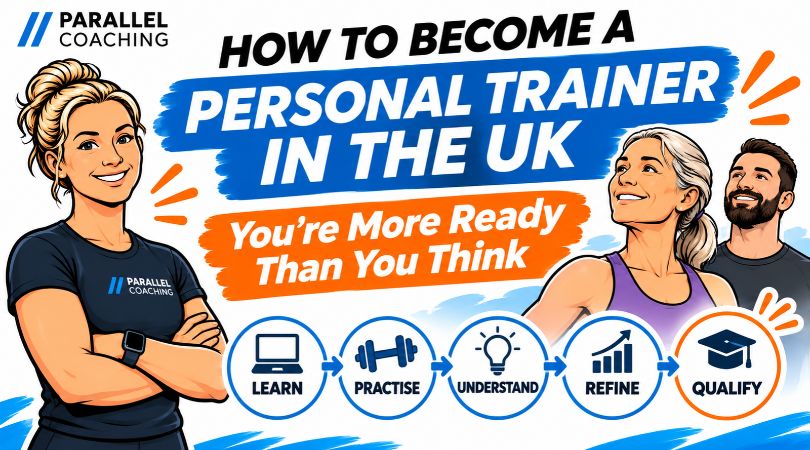
Wondering how to become a Personal Trainer in the UK but worried about finding the time, returning to education or changing careers? Discover what the qualification journey really looks like and why you might already have more of the skills you need than you realise.
You’ve thought about becoming a Personal Trainer.
Perhaps you’ve been thinking about it for months or even years.
You enjoy fitness, you’re interested in how the body works, and you’d love to help other people experience the benefits of exercise.
However, every time you get close to taking the next step, a few questions creep in.
- Am I too old?
- Where will I find the time?
- What if I struggle with studying again?
- What if I’m just not ready?
These are conversations we have regularly with prospective learners at Parallel Coaching.
Let me introduce you to Hannah.
Meet Hannah: 54, Busy and Ready for Something Different
Hannah works full-time as a carer in a retirement home. She works shifts, has a big family and still finds herself running around after her children, despite them all being adults.
Hannah attends a local exercise class a couple of times a week and enjoys taking part in parkrun.
She doesn’t train in a gym and was unfamiliar with much of the equipment you’d typically find on a gym floor.
At 54, Hannah was beginning to think seriously about her future. She couldn’t see herself still providing physically demanding personal care at 65.
Becoming a Personal Trainer appealed to her, although she questioned whether she had the knowledge, ability or confidence to make it happen.
She hadn’t studied for years. She was already busy. The gym environment felt unfamiliar, and becoming a Personal Trainer seemed well outside her comfort zone.
Sound familiar?
We’ll come back to Hannah’s story shortly.
Am I Too Old to Become a Personal Trainer in the UK?
Walk into our Milton Keynes Academy on a training weekend and you might be surprised by who you meet.
Our learners come from different careers, backgrounds and generations. Many are in their 40s and 50s, bringing years of professional and personal experience into the classroom.
That experience matters.
Being a Personal Trainer involves much more than understanding exercise. It’s about listening to people, understanding their challenges, communicating clearly and helping them work towards meaningful goals.
Consider Hannah’s background in social care.
Every day, she communicates with different people, adapts to individual needs, demonstrates patience and helps others maintain their independence.
These are valuable qualities in a Personal Trainer.
Perhaps you’ve spent years managing a team, teaching, working in healthcare, supporting customers or raising a family.
You’ve probably already developed skills that will serve you well as a coach.
You’re learning a new profession, not starting from zero.
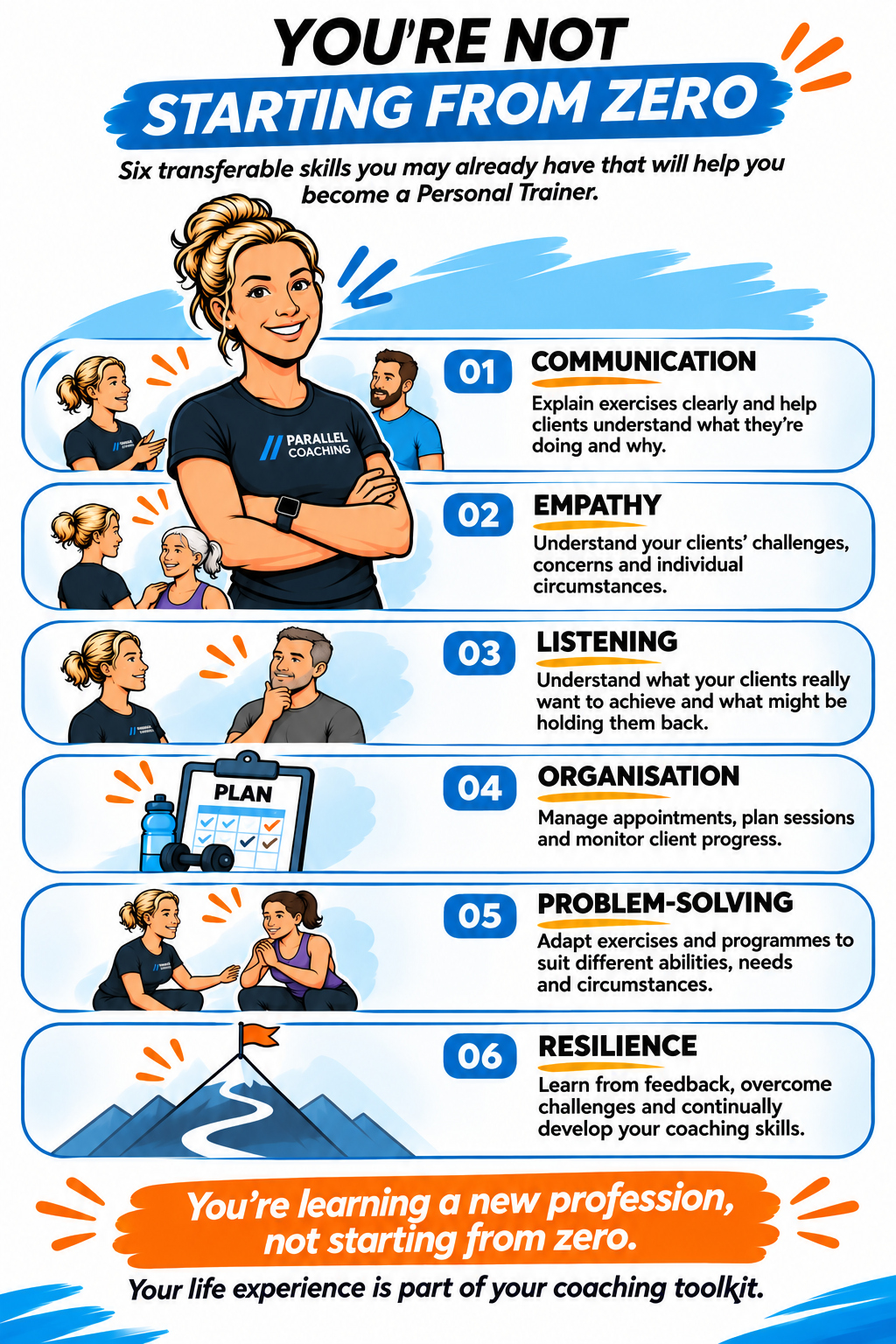
Your qualification helps you build upon these existing strengths while developing your technical knowledge and practical coaching skills.
How to Become a Personal Trainer When You’re Already Busy
Between work, family, training and everything else life throws at you, finding additional time can feel challenging.
Studying doesn’t have to mean disappearing into a textbook for three hours every evening.
Imagine watching a 25-minute Anatomy and Physiology tutorial one evening and spending 15 minutes revisiting your notes the next day.
Later in the week, during your own exercise session, you explore how that knowledge relates to the movements you’re performing.
At the weekend, you complete part of a worksheet.
Each activity contributes to your learning.
At Parallel Coaching, we combine flexible online home study with practical, face-to-face training at our Milton Keynes Academy.
You can organise your home study around your existing commitments, with dedicated attendance weekends to focus on developing your practical skills.
Becoming a Personal Trainer requires commitment, although that commitment doesn’t have to come at the expense of everything else in your life.
How Hard Is It to Become a Personal Trainer?
Perhaps you haven’t studied for 20 or 30 years, and your last experience of education involved memorising information, sitting behind a desk and preparing for exams.
Learning to become a Personal Trainer can look very different.
Imagine you’re learning about the muscles involved in a squat.
You watch a tutorial, explore the anatomy and begin understanding the joint actions.
You then perform the exercise yourself, practise demonstrating it to someone else, observe their movement and receive feedback on your instruction.
Suddenly, the information you’ve been studying starts to make much more sense.
You’re connecting theory to something real.
You don’t have to understand everything before you start practising. Sometimes practising is what helps you understand.
There will inevitably be topics you find more challenging than others. That’s a natural part of learning something new.
Having access to tutors, practical workshops, learning resources and ongoing feedback means you have support throughout that process.
Your previous experience of education doesn’t have to define your next one.
Do You Need Gym Experience to Become a Personal Trainer in the UK?
One of Hannah’s biggest concerns was her lack of experience using gym equipment.
Perhaps you’ve never used a cable machine, performed a barbell deadlift or adjusted a resistance machine.
You might enjoy running, swimming, cycling or attending exercise classes without regularly training in a gym.
You don’t need to arrive knowing how every piece of equipment works.
During your Level 2 Gym Instructor training, you’ll develop your understanding of gym equipment, exercise technique and how to instruct others safely and effectively.
You’ll have opportunities to perform exercises, ask questions, explore different equipment and practise coaching other learners.
Remember, you’re enrolling on a course to develop these skills, not to prove you already have them.
How Long Does It Take to Become a Personal Trainer in the UK?
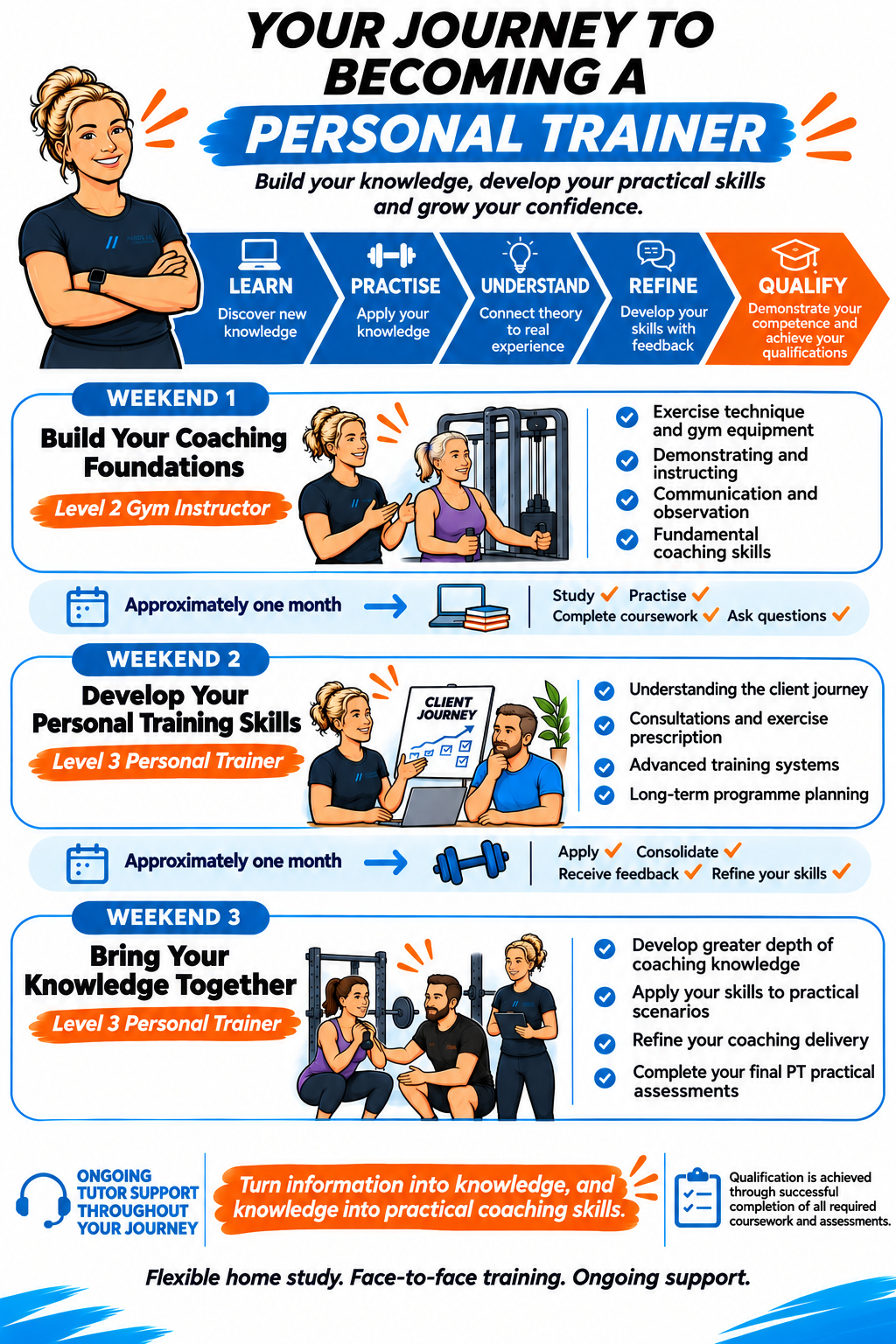
Our Master Personal Trainer Diploma includes three practical attendance weekends, typically spaced approximately one month apart, alongside flexible online home study and coursework.
The practical training takes place across approximately two months, with your overall qualification completion time depending on your home study, coursework and assessment progress.
Each attendance weekend builds upon the previous one.
Weekend 1 — Building Your Coaching Foundations
As part of your Level 2 Gym Instructor qualification, you’ll develop the foundations of effective coaching.
You’ll explore exercise technique, gym equipment, demonstrations, observation and how to communicate effectively with clients.
Following your first weekend, you’ll have time to revisit your learning, practise your new skills and complete coursework before returning.
Weekend 2 — Developing Your Personal Training Skills
Moving into your Level 3 Personal Trainer qualification, you’ll dive deeper into the client journey.
You’ll explore consultations, individualised exercise prescription, advanced training systems and long-term programme planning.
Rather than simply learning more exercises, you’ll begin exploring why, when and how to use them with different clients.
Weekend 3 — Bringing Your Coaching Knowledge Together
Your final attendance weekend adds further depth to your coaching knowledge and practical application.
You’ll bring together the skills you’ve developed throughout the course, refine your delivery and complete your final Personal Trainer practical assessments.
The time between weekends is an important part of the learning process.
Having multiple points of contact with your tutors allows you to return with questions, share your experiences and build upon what you’ve previously learned.
You’ll also have access to ongoing tutor support, learning resources and constructive feedback throughout your course.
It’s about turning information into knowledge, and knowledge into practical coaching skills.
What If You Don’t Feel Confident Enough?
Confidence isn’t something you’re expected to bring with you on your first training weekend. It’s something you develop through learning and experience.
Your first exercise demonstration might feel unfamiliar. You might forget a teaching point or find it difficult to explain something you’ve recently learned.
With further practice, feedback and opportunities to try different approaches, those unfamiliar tasks gradually become more comfortable.
That’s why we place so much emphasis on practical learning.
You don’t need to be a confident Personal Trainer before enrolling on a Personal Trainer course. Becoming one is the purpose of the course.
What Qualifications Do You Need to Become a Personal Trainer in the UK?
If you’re new to the fitness industry, a recognised qualification pathway typically includes two stages:
- Level 2 Gym Instructor: Develop your foundational exercise knowledge and gym-based coaching skills.
- Level 3 Personal Trainer: Learn to work with individual clients, understand their needs and design personalised exercise programmes.
Our Master Personal Trainer Diploma combines these qualifications into one learning pathway, with flexible home study and three face-to-face attendance weekends at our Milton Keynes Academy.
Once you’ve qualified, you don’t necessarily have to leave your existing career.
You might want to coach part-time, work in a gym, build your own business or progress into other areas of the fitness industry.
Explore the possibilities in our blog: 6 Fitness Career Paths: What Happens After Qualifying?
Remember Hannah? Here’s Where She Is Now
Hannah qualified as a Personal Trainer in the summer of 2026.
She’s still working in social care, managing her shifts and juggling family commitments.
However, she now has five Personal Training clients alongside her existing job.
Her next step is to complete her Level 2 Circuit Training Instructor qualification and start running her own local exercise class.
She’s planning to reduce her hours in social care by a day or two each week, creating more time to develop her fitness business by spring 2027.
Hannah hasn’t needed to walk away from her existing career or completely change her life overnight.
She’s gradually building something new alongside it.
The same person who questioned whether she would be any good as a Personal Trainer is now coaching five people and planning the next stage of her fitness career.
Sometimes you only discover what you’re capable of once you give yourself the opportunity to try.
Your Next Step Towards Becoming a Personal Trainer
You don’t need to have your entire future mapped out, know every muscle in the body or feel completely confident about returning to education.
What you need is a willingness to learn, practise and develop.
You might already have more of the qualities needed to become a great coach than you realise.
Want to explore how becoming a Personal Trainer could fit into your life?
Book a career chat with us. We can talk through your goals, your existing commitments, the qualifications and what your learning journey could look like.
Book a Call With Parallel Coaching
Alternatively, explore our Master Personal Trainer Diploma, including full course details and upcoming attendance dates.
Explore the Master Personal Trainer Diploma and Course Dates
Dedicated to More
Hayley “How to Become a Personal Trainer in the UK” Bergman
Parallel Coaching
P.S. You can also find us on the following platforms:
Instagram: instagram.com/parallelcoaching
Facebook: https://www.facebook.com/ParallelCoaching
YouTube: http://bit.ly/2F1Z1bs
Read more blogs about becoming a gym instructor: HERE
TrustPilot Reviews: HERE