
Discover five essential circuit training instructor skills, from planning and voice control to adapting exercises and coaching groups confidently.
You’re a qualified fitness professional.
You’re comfortable demonstrating exercises, correcting technique and motivating your clients.
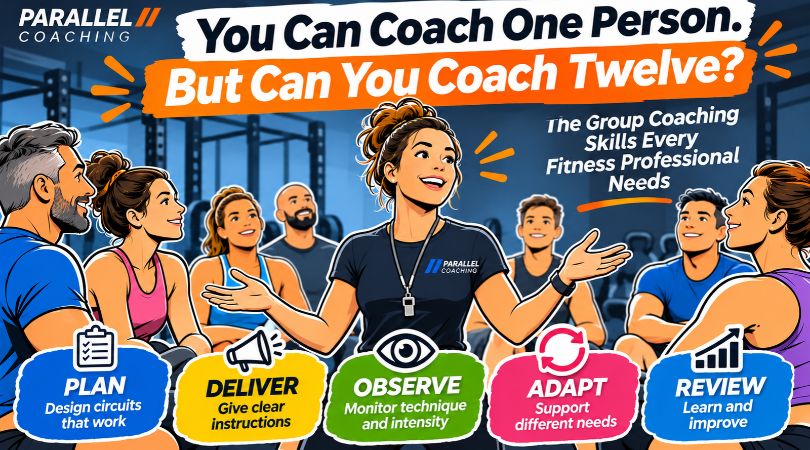
You Can Coach One Person. But Can You Coach Twelve?
But imagine walking into a gym and finding 12 people waiting for you to deliver a circuit class.
One needs an easier exercise option. Another isn’t working hard enough. Someone at the back hasn’t understood your instructions.
And the timer is already counting down!
Coaching 12 people isn’t simply coaching one person 12 times.
It’s about managing multiple people, different abilities and competing demands while keeping the session safe, effective and enjoyable.
That’s why group instruction is a skill in its own right.
What Is Circuit Training, Really?
Circuit training isn’t just burpees, battle ropes and someone shouting encouragement!
It’s a flexible way of organising exercises into stations or sequences, often using planned work and recovery periods.
Circuits can develop cardiovascular fitness, muscular endurance, strength and other fitness components, depending on how they’re designed.
They might involve resistance exercises, bodyweight movements, cardiovascular activities or a combination.
From small-group PT and outdoor bootcamps to gym-based classes and HYROX-style sessions, the possibilities are varied.
The exercises don’t make a great circuit. The planning and coaching do.
Why Are Circuit Training Instructor Skills Different?
When coaching one person, your attention is focused on their technique, intensity, feedback and progress.
With 12 participants, you’re monitoring these things simultaneously while managing equipment, timings, transitions and the overall session.
Your Level 2 Gym Instructor or Level 3 Personal Trainer qualification provides valuable coaching foundations.
But delivering group exercise introduces additional practical demands.
The challenge isn’t simply having more people. It’s knowing how to divide your attention without losing control of the session.
Five Skills Every Circuit Training Instructor Needs
1. PLAN — Prepare for the People, Not Just the Exercises
Before designing a circuit, consider participants’ goals, abilities, exercise experience and relevant health information.
Appropriate screening, suitability checks and professional scope still matter in group exercise.
Plan exercise options, equipment, station layouts and timings before participants arrive.
A circuit needs to work in the room, not just on paper.
2. DELIVER — Make Instructions Clear
Good demonstrations, concise teaching points and effective voice control help participants understand what they’re doing.
Consider where you’re standing. Can everyone see and hear you?
Explain the exercise, demonstrate key techniques and establish how the circuit will operate before starting.
3. OBSERVE — Coach Rather Than Join In
It’s tempting to exercise alongside the group, particularly when you’re trying to create energy.
But if you’re completing every repetition, who’s watching the participants?
Demonstrate when necessary, then move around the room, observe technique, monitor intensity and provide useful feedback.
Your job is to coach the circuit, not complete it.
4. ADAPT — Keep Everyone Moving Appropriately
Not everyone needs the same exercise or intensity.
Prepare suitable alternatives and adjust resistance, movement complexity or exercise demands when appropriate.
The aim is to support individual needs without unnecessarily interrupting the entire group.
5. REVIEW — Learn From Every Session
Effective coaching doesn’t finish when the timer stops.
Were your instructions understood? Did participants work at appropriate intensities? Were transitions smooth?
What would you change next time?
Reviewing your delivery helps you improve future sessions.
Twelve Participants. Three Different Needs.
Imagine you’re delivering a circuit containing squats, rows, step-ups and cardiovascular exercises.
At the squat station, three participants have different needs.
Participant A is new to resistance training and struggles to control their squat depth. A bodyweight squat to a box might provide an appropriate starting point.
Participant B has good technique but finds the exercise too easy. An appropriately loaded goblet squat could increase the challenge.
Participant C is comfortable with the movement but needs a different intensity. Adjusting the load, repetitions or tempo may be appropriate.
These aren’t automatic progressions. They’re individual coaching decisions based on what you’ve observed and what you know about each participant.
Meanwhile, someone at another station needs a technique correction, and the next transition is approaching.
How do you manage everything?
Preparation, positioning and concise coaching cues.
By planning exercise options in advance, positioning yourself where you can observe participants and using clear instructions, you can respond without constantly stopping the class.
It’s also why screening and knowing participants’ relevant needs before the session matters.
Why Face-to-Face Circuit Training Instructor Skills Matter
You can learn a great deal about circuit training through online tutorials, exercise demonstrations and written resources.
But there’s a difference between understanding group coaching and confidently delivering it.
At our Parallel Coaching Academy in Milton Keynes, learners practise planning, demonstrating, instructing, observing and adapting exercises with real people.
Our Level 2 Circuit Training course includes practical workshops covering session planning, group delivery, exercise adaptations and reviewing performance.
You can experiment with instructor positioning, practise projecting your voice and receive feedback on your coaching.
These are skills that develop through doing, not simply watching.
The Coach’s Takeaway
Being a great fitness professional doesn’t automatically make you a confident group instructor.
But the coaching foundations you’ve already developed provide an excellent starting point.
The next step is learning how to apply those skills when you’re responsible for an entire room.
And that opens opportunities to deliver circuit classes, small-group PT, outdoor sessions and other group-based fitness services.
Ready to Coach More Than One Person and Become a Circuit Training Instructor?
Our Level 2 Circuit Training Instructor course at Parallel Coaching’s Milton Keynes Academy helps fitness professionals develop the practical skills needed to plan, deliver, adapt and review group exercise sessions.
You’ll practise coaching, receive feedback and develop confidence managing different participants within the same session.
Because knowing 12 exercises is one thing.
Knowing how to coach 12 people is another.
Explore our Level 2 Circuit Training course and develop your group coaching skills.
https://courses.parallelcoaching.co.uk/products/level-2-circuit-instructor-course
Dedicated to More
Hayley “Circuit Training Instructor: Can You Coach 12 People?” Bergman
Parallel Coaching
P.S. You can also find us on the following platforms:
Instagram: instagram.com/parallelcoaching
Facebook: https://www.facebook.com/ParallelCoaching
YouTube: http://bit.ly/2F1Z1bs
Read more blogs about becoming a circuit training instructor: HERE
TrustPilot Reviews: HERE