
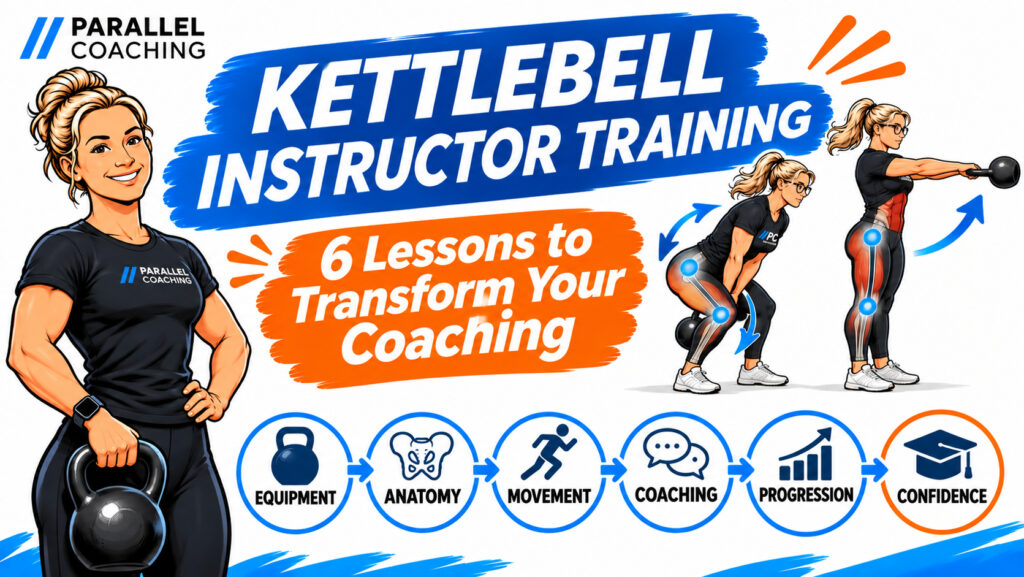
Discover how kettlebell instructor training can transform your understanding of exercise, connect Anatomy and Physiology to movement and develop your confidence in coaching clients.
Is Your Kettlebell Just Another Weight?
If I took the kettlebells out of your client’s programme and replaced them with dumbbells, would anything really change?
Perhaps you use kettlebells for goblet squats, upright rows and the occasional swing.
You know a handful of exercises, although you’re still questioning whether you’re performing the swing correctly yourself.
Are you really hinging at the hips? Are you generating enough force? Could you confidently teach someone else?
Kettlebells are often overlooked or used simply as an alternative weight, not because they lack versatility, but because we lack the knowledge and confidence to explore their potential.
What Makes Kettlebell Training Different?
Unlike a dumbbell, the centre of mass of a kettlebell sits outside its handle.
Depending on how you hold and move the kettlebell, this influences leverage, stability demands and how forces act on the body.
Moving between goblet, suitcase, rack and overhead positions creates different muscular and mechanical demands.
Ballistic exercises, such as swings and cleans, also introduce opportunities to explore acceleration, deceleration and rapid force production.
However, picking up a kettlebell doesn’t automatically mean you’re training for power, strength or muscular endurance.
The equipment doesn’t determine the outcome. Your exercise prescription influences it.
Kettlebell Swing Anatomy: Your Coaching Secret Weapon
One of the most valuable skills you can develop as a fitness professional is understanding the two-way relationship between Anatomy and Physiology and exercise.
You can start with your client’s goal, identify the anatomical and physiological adaptations required and select an appropriate training stimulus.
Equally, you can observe an exercise and identify the joint actions, muscular involvement, energy demands and potential adaptations.
Consider the kettlebell swing.
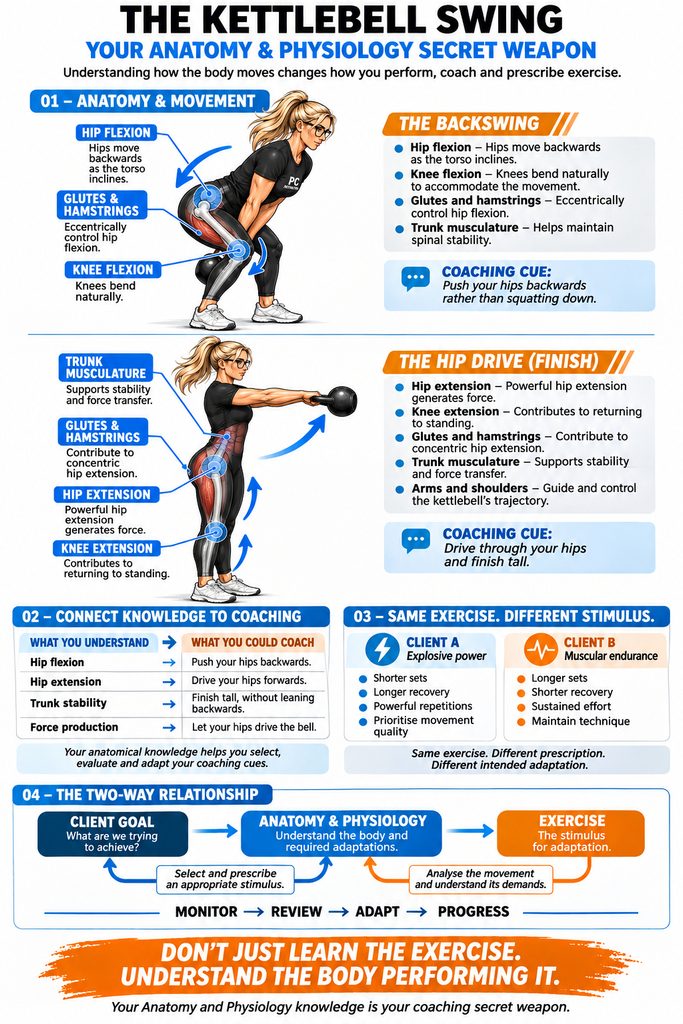
During the backswing, hip flexion occurs as the hips move backwards, with the glutes and hamstrings helping control the movement eccentrically.
Powerful hip extension then drives the kettlebell forwards, while the trunk muscles help maintain stability and transfer force.
Understanding these actions influences how you coach.
Instead of simply telling your client to swing the kettlebell higher, you might ask them to drive their hips forwards or finish tall without leaning backwards.
Your anatomical knowledge gives you a reason for selecting a particular coaching cue and the understanding to change it if necessary.
You’re no longer simply repeating instructions you’ve heard someone else use.
Explore this relationship further in our blog: Why Do Personal Trainers Need Anatomy and Physiology? Supersets Explained.
Kettlebell Progressions: More Than Increasing Resistance
Imagine two clients performing a two-handed kettlebell swing.
Client A wants to develop explosive hip power. You might prescribe shorter sets with longer recovery periods, prioritising high-quality, powerful repetitions.
Client B wants to improve muscular endurance and conditioning. Longer sets and shorter recovery periods may be appropriate, provided technique remains consistent.
The exercise hasn’t changed, but the intended training stimulus has.
You could also introduce single-handed swings, creating different demands on grip, shoulder control and trunk stability without necessarily increasing resistance.
Progression doesn’t always mean heavier, faster or more complicated.
Progress towards the adaptation your client needs, not simply towards a heavier kettlebell.
Kettlebell Instructor Training: Performing vs Coaching
Performing a kettlebell exercise confidently is an important starting point. Coaching that exercise introduces additional challenges.
Can you identify why your client is struggling to hinge at the hips?
Can you adapt your instructions, change your teaching position or introduce a suitable regression?
Could you confidently deliver a kettlebell session to twelve participants with different abilities?
Developing these skills requires practical experience, observation and feedback.
Confidence grows when you understand what you’re doing, why you’re doing it and how to adapt your approach for the person in front of you.
Become a Level 2 Kettlebell Instructor
Our Level 2 Kettlebell Instructor course at Parallel Coaching’s Milton Keynes Academy helps you develop these skills through one day of face-to-face training.
Across four workshops, you’ll explore exercise technique, coaching, programming, adaptations and progression for individual clients and groups.
Approximately 80–90% of your attendance day is practical, with ongoing assessment, tutor feedback and a supporting worksheet.
Upon successful completion, you’ll receive the Ofqual-regulated Focus Awards Level 2 Award in Instructing Kettlebell Exercises, alongside two additional certificates.
You don’t need previous kettlebell experience, although you must hold or be working towards a recognised Level 2 Fitness Instructor qualification.
Remember, the kettlebell is the equipment. Exercise provides the stimulus. Your knowledge connects that stimulus to your client’s goal.
Don’t just learn the exercise. Understand the body performing it.
Explore our Level 2 Kettlebell Instructor Course and Upcoming Dates
Dedicated to More
Hayley “Kettlebell Instructor Training: More Than Just Another Weight” Bergman
Parallel Coaching
P.S. You can also find us on the following platforms:
Instagram: instagram.com/parallelcoaching
Facebook: https://www.facebook.com/ParallelCoaching
YouTube: http://bit.ly/2F1Z1bs
Read more blogs about becoming a circuit training instructor: HERE
TrustPilot Reviews: HERE