
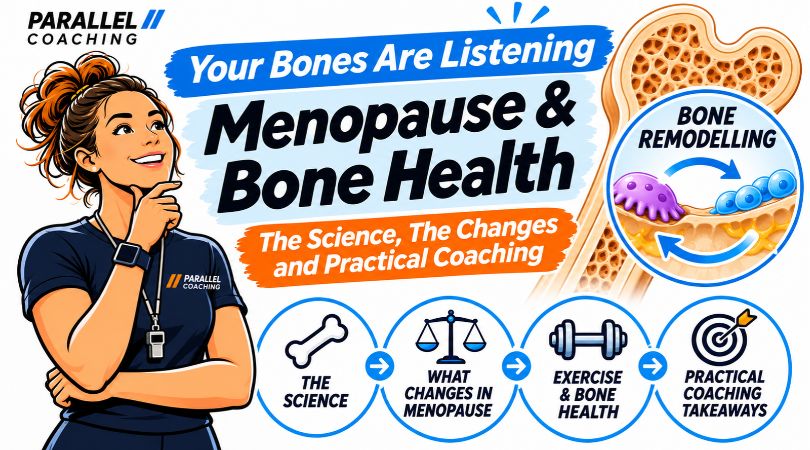
When you programme a squat, you probably think about muscles, movement and strength. But have you considered bone health during menopause? Discover how bone remodelling works, why menopause matters and how exercise can influence skeletal health.
When your client performs a squat, you probably think about their quadriceps, glutes and movement technique.
But there’s another tissue responding to the forces involved.
Bone.
Your client’s skeleton isn’t simply a rigid framework supporting movement. Bone is living tissue that continually renews itself and responds to mechanical loading.
Understanding this process gives you another valuable reason to consider why you’re selecting an exercise, particularly when coaching women through menopause.
What Happens Inside Bone?
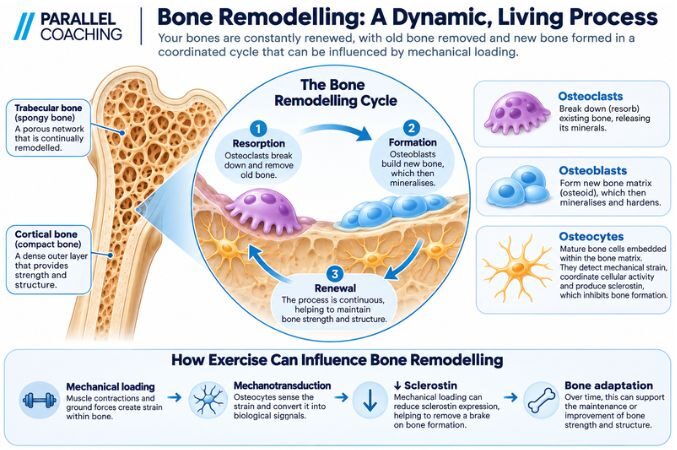
Bone continually renews itself through a process called bone remodelling.
Three cell types play important roles: osteoclasts resorb existing bone, osteoblasts form new bone, and osteocytes help regulate the process.
Osteocytes are particularly fascinating. Embedded within bone, they detect mechanical strain, including signals associated with fluid movement through microscopic channels.
This process, called mechanotransduction, converts mechanical forces into biological signals.
One important regulator is sclerostin, a protein produced by osteocytes that inhibits signalling involved in bone formation. Mechanical loading can reduce sclerostin expression, helping create conditions that support bone formation.
However, bone adaptation is gradual, taking place over months and years rather than during an individual workout.
Why Does Bone Health During Menopause Matter?
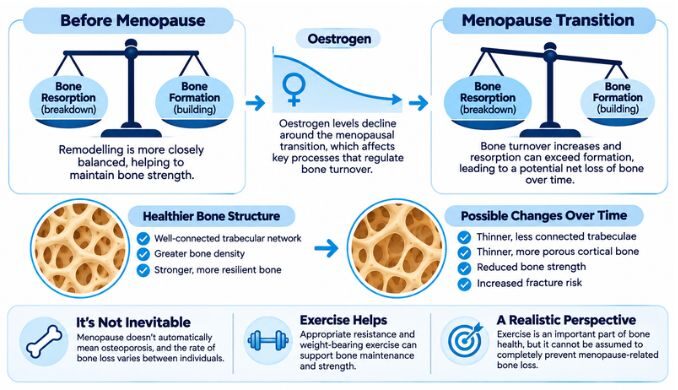
Oestrogen helps maintain the balance between bone formation and resorption.
One way it does this is through the RANKL–OPG signalling system, which regulates osteoclast development and activity.
RANKL promotes osteoclast formation, while osteoprotegerin (OPG) acts as a decoy receptor that binds RANKL and helps limit this process.
As oestrogen declines around menopause, changes in this signalling system and other regulatory pathways can favour greater osteoclast activity, increasing bone resorption.
When resorption exceeds formation, bone is gradually lost.
This can affect both bone mineral density and bone microarchitecture. The internal trabecular network may become thinner and less connected, while the outer cortical bone can become thinner and more porous.
These changes can reduce bone strength and increase fracture risk.
However, menopause doesn’t automatically mean osteoporosis. Bone loss varies between individuals, and appropriate exercise can support skeletal health without guaranteeing that bone loss will be prevented.
Not All Exercise Loads Bone Equally
Here’s where your Anatomy and Physiology knowledge becomes particularly useful.
A client who cycles or swims regularly may have excellent cardiovascular fitness and muscular endurance.
But these activities provide relatively little weight-bearing impact.
Bone responds to the mechanical stimulus it receives, including the magnitude, rate, direction and location of loading.
Progressive resistance training creates forces through the skeleton via muscle contractions and external resistance.
Appropriate impact exercise can introduce rapid ground-reaction forces that provide an additional bone-loading stimulus.
Importantly, adaptation is site-specific. Loading the hip doesn’t necessarily produce the same response at the spine.
Walking remains valuable for health and function, but familiar, low-intensity walking alone may provide insufficient stimulus to substantially increase bone density.
The coaching lesson?
Being physically active doesn’t automatically mean every tissue is receiving the stimulus it needs.
Putting Bone Health During Menopause Into Practice
Imagine you’re coaching a 52-year-old woman approaching menopause.
She cycles regularly, swims twice a week and wants to protect her bone health.
Rather than replacing activities she enjoys, consider what her current programme might be missing.
Following appropriate screening, you could introduce progressive resistance training using exercises such as squats, hinges, step-ups, rows and presses.
As her technique, strength and confidence develop, you can progressively adjust the resistance and training demands.
You might also consider suitable weight-bearing or impact activities, depending on her ability, experience and fracture risk.
However, if she has osteoporosis, previous fragility fractures or other significant risk factors, exercise selection and progression require additional care and, where appropriate, clinical guidance. For clients at increased vertebral fracture risk, particular caution is needed with heavily loaded or repeated end-range spinal flexion.
Your role isn’t to diagnose osteoporosis or interpret bone scans. It’s to recognise relevant risks, work within your scope and make informed exercise decisions.
And remember, bone health isn’t just about bone density.
Improving muscle strength, balance and functional capacity can also help reduce falls risk, an important consideration in fracture prevention.
The Coach’s Takeaway
Next time you’re planning a client’s programme, consider more than the muscles being worked.
Think about the forces travelling through their skeleton, the adaptations you’re trying to encourage and whether your exercise choices provide an appropriate stimulus.
You don’t need to become a bone specialist to make better coaching decisions. But understanding how bone responds to exercise gives you another valuable piece of the programming puzzle.
At Parallel Coaching, our Level 3 Women’s Health and Menopause qualification helps you develop the knowledge and confidence to understand women’s health and apply it to practical exercise coaching.
Discover our Level 3 Women’s Health & Menopause Course
Dedicated to More
Hayley “Bone Health During Menopause” Bergman
Parallel Coaching
P.S. You can also find us on the following platforms:
Instagram: Follow Parallel Coaching
Facebook: Join us on Facebook
YouTube: Watch Parallel Coaching on YouTube
More Blogs: Read our Women’s Health and Menopause blogs
Trustpilot: Read our learner reviews