
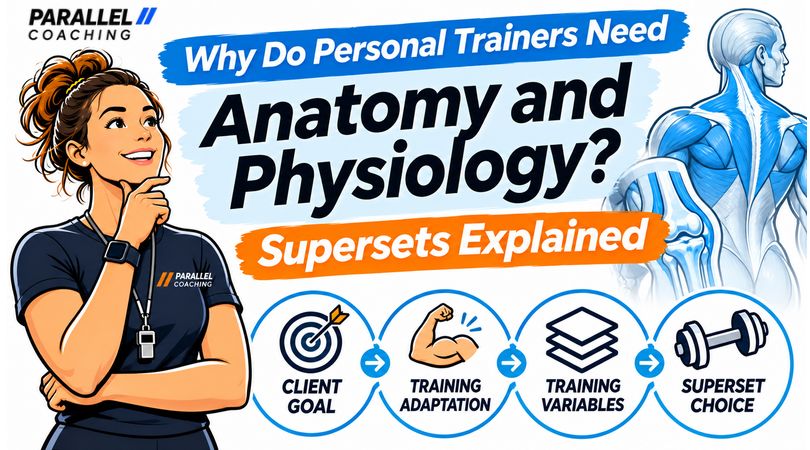
Think Anatomy and Physiology for Personal Trainers is just about passing an exam?
Think again.
Understanding muscles, movement and training adaptations helps you make more informed programming decisions. Discover how this knowledge influences exercise selection, training variables and progression, using supersets as a practical example.
“Why do I need to learn all these muscles?”
“Will I actually use Anatomy and Physiology once I’ve qualified?”
Perhaps you’ve asked these questions yourself.
And we understand why. When you’re studying muscles, joint movements, energy systems and the nervous system, it’s not always obvious how everything connects to coaching.
But here’s something we’ve noticed.
You might be starting your programme design by choosing exercises. Yet exercises should be one of the last decisions you make.
Let’s explain why Anatomy and Physiology for Personal Trainers is important … using supersets as an example.
Stop Starting With Exercises
Think about how often you search for new exercises.
Perhaps your client seems bored, or you’re worried that repeating familiar movements will make sessions less interesting.
So you introduce different exercises, new variations or another training system.
But here’s the question.
Is your programme actually progressing, or are you simply changing the exercises?
Variety can be valuable. However, constantly changing exercises doesn’t necessarily create the consistent training stimulus needed for adaptation.
Effective programming starts somewhere else entirely.
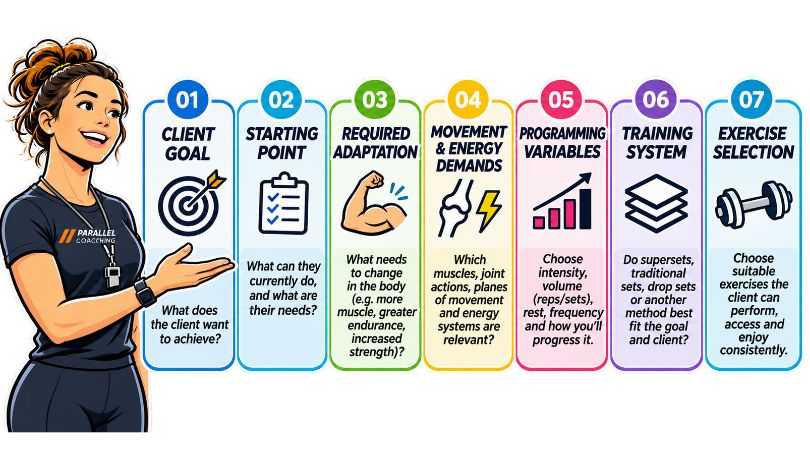
Start With Your Client, Not the Exercise
Before choosing a squat, row or superset, ask yourself three questions.
- What does your client want to achieve?
- Consider their current starting point?
- What needs to change anatomically or physiologically to achieve that goal?
For example, if your client wants to build muscle, you need to create an appropriate hypertrophy stimulus.
If they’re preparing for a long-distance cycling event, you’ll need training that develops the relevant aerobic capacity, muscular endurance and performance demands.
Different goals require different adaptations.
And understanding those adaptations is exactly why you study Anatomy and Physiology.
Let Anatomy and Physiology for Personal Trainers, Guide Your Programme
Once you’ve identified the required adaptation, you can begin making informed programming decisions.
Which muscles and joint actions are involved? What planes of movement are relevant? Which energy systems need developing?
Then consider the acute training variables.
Intensity, volume, repetitions, sets, rest periods, frequency and exercise order all influence the training stimulus.
You can plan and progressively adjust these variables to support the desired adaptation.
Only then should you decide whether a particular training system, such as supersets, helps achieve your client’s goal.
And finally, select exercises that provide the intended stimulus and suit the individual.
Supersets: Same Method, Different Purpose
A superset involves performing two exercises consecutively, usually with little or no rest between them, before taking a planned recovery period.
Exercise A → Exercise B → Rest → Repeat
But knowing that definition doesn’t explain which exercises you should pair.
That’s where your A&P knowledge comes in.
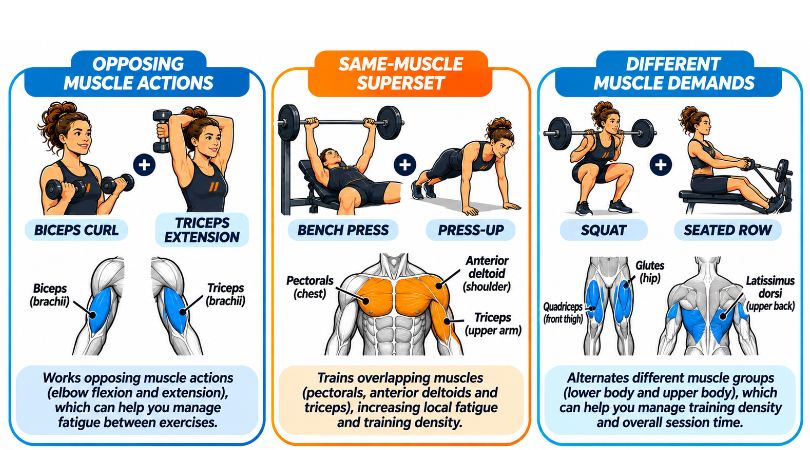
1. Opposing Muscle Actions
Consider pairing a biceps curl with a triceps extension.
The biceps contribute to elbow flexion, while the triceps produce elbow extension.
Understanding agonists, antagonists and muscle actions helps you recognise why these exercises can work together.
You might remember learning about reciprocal inhibition, where neural mechanisms reduce antagonist muscle activity during certain movements.
However, this doesn’t automatically mean opposing-muscle supersets produce better recovery or greater muscle growth.
Understanding the physiology helps inform your choices, not guarantee the outcome.
2. Same-Muscle Supersets
Now consider pairing a bench press with press-ups.
Both exercises involve overlapping working muscles, including the pectorals, anterior deltoids and triceps.
This creates repeated demands on similar muscles, increasing local fatigue.
You might use this pairing within some hypertrophy programmes, but remember that fatigue can also reduce repetitions, loading and movement quality.
More fatigue doesn’t automatically mean better results.
3. Different Muscle Demands
What about pairing a squat with a seated row?
These exercises primarily challenge different muscle groups, potentially allowing one region some recovery while another works.
Upper–lower and push–pull pairings can help you manage training density.
However, demanding compound exercises can still create substantial cardiovascular and whole-body fatigue.
And remember, push–pull pairings may overlap with agonist–antagonist categories, depending on the exercises.
The Best Superset Depends on Your Client
Imagine you’re working with three different clients.
Client A wants to build muscle but only has 40 minutes to train.
You might pair a chest press with a seated row to help them complete their planned training volume efficiently.
Client B wants additional hypertrophy-focused work.
You might use a bench press followed by press-ups, provided their technique and recovery remain appropriate.
Client C wants to maximise strength in a heavy compound lift.
Here, traditional sets with longer recovery periods might be more appropriate than a demanding superset.
The training system should follow your client’s goal, not the other way around.
And remember, minimal rest between exercises doesn’t mean eliminating recovery after the pairing.
Your rest periods should support the intended training outcome.
Practical considerations matter too. Equipment availability, exercise transitions and your client’s ability to maintain technique can all influence whether a superset works.
Unlike supersets, drop sets typically involve reducing the resistance and continuing the same exercise. Both methods have a place, but neither should be chosen simply because it makes training feel harder.
Don’t Forget the Most Important Ingredient: Consistency
Here’s where your exercise selection becomes particularly important.
Once you’ve identified the training stimulus required, there may be several exercises that can deliver it.
So why not choose movements your client enjoys, feels confident performing and can access consistently?
The best-looking programme on paper achieves very little if your client doesn’t follow it.
Enjoyment can support adherence. And adherence creates repeated opportunities to apply the training stimulus, progressively develop the programme and achieve the intended adaptations.
That doesn’t mean every exercise must be entertaining or comfortable.
It means your programme needs to be appropriate, effective and sustainable.
Consistency isn’t a substitute for good programming. It’s what allows good programming to work.
You Use Anatomy and Physiology for Personal Trainers More Than You Think
When you analyse movement, select training variables, manage fatigue, plan progression or decide whether a superset is appropriate, you’re applying Anatomy and Physiology.
You might not consciously recall every muscle origin, insertion or nerve pathway.
But that knowledge underpins your reasoning.
At Parallel Coaching, this is why we encourage you to connect theory to practical coaching.
Through our Level 2 Gym Instructor and Level 3 Personal Trainer qualifications, we combine flexible home study with face-to-face learning at our Milton Keynes Academy.
Because we don’t just want you memorising information for assessments.
We want you to understand how to use it when working with real people.
The Coach’s Takeaway
Stop starting with exercises.
Start with your client’s goal, understand their starting point and identify the anatomical and physiological adaptations required.
Use that knowledge to plan training variables, progression and suitable training systems.
Then choose exercises that deliver the intended stimulus and that your client can perform and enjoy consistently.
You don’t learn Anatomy and Physiology just to pass an exam. You learn it to make better coaching decisions long after you’ve qualified.
Need more help with your anatomy knowledge? Our revision bootcamps can help… https://courses.parallelcoaching.co.uk/products/revision-bootcamps
Discover our Level 2 Gym Instructor and Level 3 Personal Trainer qualifications and learn how to connect theory with practical coaching.
Want to find out more?
Train To Become A Fitness Professional and turn your passion for fitness into a rewarding career.
Choose the route that suits where you are now.
- New to fitness? Start with Level 2 Gym Instructor.
- Want the complete pathway? Combine both qualifications with our L3 Personal Trainer Diploma.
- Already Level 2 qualified? Progress straight to Level 3 Personal Trainer.
Explore the Parallel Coaching Fitness Qualifications and Get Started →
https://courses.parallelcoaching.co.uk/products/become-a-personal-trainer
Dedicated to More
Hayley “Anatomy and Physiology for Personal Trainers – Applied Supersets” Bergman
Parallel Coaching
P.S. You can also find us on the following platforms:
Instagram: instagram.com/parallelcoaching
Facebook: https://www.facebook.com/ParallelCoaching
YouTube: http://bit.ly/2F1Z1bs
Read more blogs about becoming a personal trainer: HERE
TrustPilot Reviews: HERE