
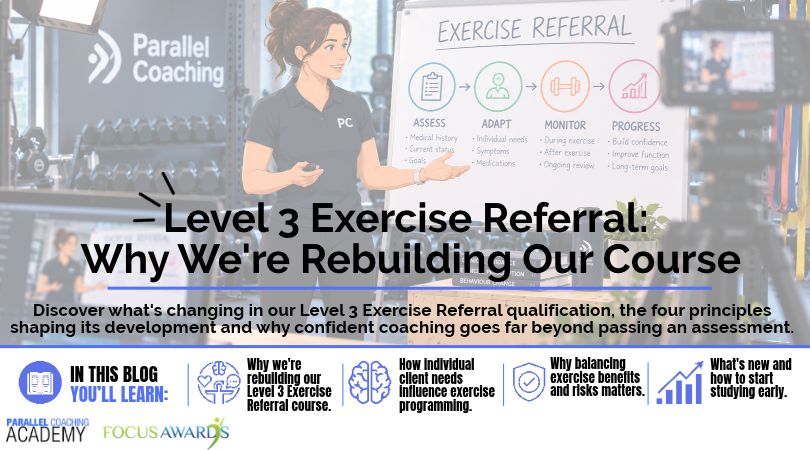
Discover what’s changing in our Level 3 Exercise Referral qualification, the four principles shaping its development and why confident coaching goes far beyond passing an assessment.
We’ve had quite a few questions recently about all the filming, researching and course development happening behind the scenes at Parallel Coaching.
Why are we recreating our Level 3 Exercise Referral course?
What’s going to be different?
And does that mean there was something wrong with the previous version?
Absolutely not!
There doesn’t have to be a problem with something to want to make it better.
We’ve been delivering Exercise Referral training since 2012, and one thing has always been incredibly important to us.
The learning journey matters just as much as the qualification itself.
We don’t simply want learners to pass their assessments. We want them to finish feeling confident that they can apply what they’ve learnt when working with real clients.
And there’s probably no qualification where this matters more than Exercise Referral.
Why Is Level 3 Exercise Referral Training So Important?
Working with clients who have long-term medical conditions can be complex.
An Exercise Referral Instructor needs to understand how different conditions affect the body, how medications and treatments may influence exercise, and how to balance potential benefits against relevant risks.
But understanding the theory is only the starting point.
The real skill is knowing how to apply that knowledge to the individual standing in front of you.
When is exercise appropriate? What needs adapting? Which symptoms require you to stop a session? And when should you refer back to a healthcare professional?
These are the decisions that make Exercise Referral different from general fitness instruction.
And they’re a huge part of why we’re rebuilding our Level 3 Exercise Referral qualification.
Four Things Every Exercise Referral Instructor Should Understand
After months of researching, writing and filming, four important principles keep coming up.
They’re shaping how we’re developing the new course, but they’re also valuable lessons for any fitness professional supporting clients with medical conditions.
1. It’s About the Client, Not Just the Condition
Imagine two clients who both have type 2 diabetes.
One regularly walks, attends the gym and manages their condition well.
The other is relatively inactive, experiences additional health complications and feels anxious about starting exercise.
Same medical condition. Two very different starting points.
Their exercise programmes shouldn’t automatically look the same.
An effective Exercise Referral Instructor considers the client’s symptoms, medical management, current fitness, goals, confidence and exercise experience.
The diagnosis provides important information, but it doesn’t tell you everything about the person.
2. It’s About Balancing Exercise Risks Against Benefits
Exercise can offer significant benefits for people living with long-term medical conditions.
However, prescribing exercise appropriately requires more than knowing which activities are beneficial.
You also need to understand relevant contraindications, medications, symptoms and how the individual responds during and after exercise.
For example, someone taking medication that influences heart rate may require a different approach to monitoring exercise intensity.
Another client may need adjustments to exercise position, duration or recovery because of their symptoms.
The aim isn’t to remove every possible risk. It’s to identify relevant risks and make informed decisions about how to manage them.
This means knowing when to proceed, adapt, stop or refer.
3. Exercise Is Just One Part of the Bigger Picture
Long-term medical conditions are rarely managed through exercise alone.
Medication, nutrition, lifestyle changes, behaviour change and input from healthcare professionals may all contribute to someone’s health and wellbeing.
Exercise Referral Instructors have an important role within this wider approach.
But they aren’t there to diagnose conditions, prescribe medication or replace medical treatment.
Understanding professional boundaries is just as important as understanding exercise programming.
Good Exercise Referral training should help fitness professionals recognise where their responsibilities begin, where they end and when collaboration or referral is needed.
4. It’s Not Always About a Cure. It’s About Quality of Life.
Exercise won’t necessarily cure someone’s medical condition.
But it may help improve strength, mobility, physical function, confidence and quality of life.
And sometimes, the most meaningful outcomes have very little to do with what happens inside a gym.
For one client, success might mean walking to the local shops without needing to stop.
For another, it might mean climbing the stairs more comfortably or feeling confident enough to enjoy a family day out.
These are real outcomes that can make a meaningful difference to someone’s everyday life.
As Exercise Referral Instructors, we need to understand what matters to the individual, rather than measuring success through fitness scores alone.
What’s Changing in Our Level 3 Exercise Referral Course?
These four principles are influencing every stage of our course redevelopment.
We’re updating the research and clinical guidance, expanding the medical conditions covered, exploring medication considerations in greater detail and including more practical coaching scenarios.
We’re also focusing on making complex information easier to understand and apply.
Because we don’t want learners simply memorising information about 34 medical conditions.
We want you to understand what that information means when you’re working with a real person.
- What you might need to ask during a consultation?
- How could a medication influence exercise?
- What adaptations might be appropriate?
- What should you monitor before progressing a programme?
That’s the difference between remembering information and knowing how to use it.
Behind the Scenes: Our New Exercise Referral Qualification
There’s been plenty happening at Parallel Coaching over the last few months
We’ve been researching, writing, creating resources and filming new tutorials to support the learning journey.
Unit 1 is already live, and our first learners are working their way through the content.
The feedback so far has been encouraging, particularly around the shorter tutorials.
Each tutorial is under 50 minutes, making it easier to complete a meaningful section of learning within a single study session.
We’re also already halfway through filming Unit 2.
There’s still plenty of work ahead, but we’re excited about how this updated qualification is coming together.
Want to Start Your Level 3 Exercise Referral Training Early?
We’re currently offering pre-launch enrolment for fitness professionals who want to begin studying before the full updated course is released.
With Unit 1 already available, you can start building your knowledge while we continue developing the remaining content.
JOIN THE LEVEL 3 EXERCISE REFERRAL WAITING LIST
We’ll share the latest course updates, pre-launch details and information about getting started.
Because passing an Exercise Referral qualification is one thing.
Having the knowledge and confidence to make a difference to someone’s life
Dedicated to More,
Hayley “Level 3 Exercise Referral” Bergman
Parallel Coaching
P.S. You can also find us on the following platforms:
Instagram: HERE
Facebook: https://www.facebook.com/ParallelCoaching
YouTube: https://bit.ly/2F1Z1bs
Read more blogs about Exercise Referral: HERE
TrustPilot Reviews