
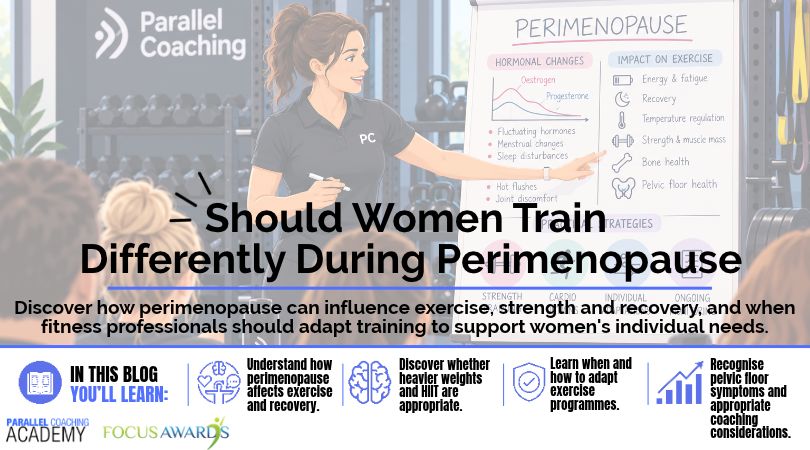
A woman in her 40s tells you she’s experiencing perimenopause. She’s heard conflicting advice about exercise during perimenopause. Should she reduce her training intensity, stop HIIT or start lifting heavier?
Should you reduce her training intensity?
Stop prescribing HIIT?
Encourage heavier weights?
The answer isn’t as simple as social media might suggest.
What Happens During Perimenopause?
Perimenopause is the transition towards menopause, when reproductive hormones, particularly oestrogen and progesterone, fluctuate. These changes can affect menstrual cycles and contribute to symptoms that influence everyday life and exercise.
Symptoms vary considerably.
Some women experience disrupted sleep, fatigue, hot flushes or joint discomfort, while others notice relatively little change.
Perimenopause doesn’t automatically mean someone needs a completely different exercise programme.
Why Might Exercise Feel Harder?
Poor sleep can affect energy, concentration, perceived effort and recovery.
A familiar workout might suddenly feel more demanding, even without a measurable decline in strength or fitness.
For example, a woman who usually completes three sets of squats comfortably might find the same session unusually tiring after several nights of disrupted sleep.
This doesn’t necessarily mean she’s lost muscle strength or fitness.
Poor sleep and fatigue may temporarily increase how demanding the same exercise feels.
This is why monitoring how exercise feels, not just the weights lifted or repetitions completed, can be useful.
Symptoms and exercise tolerance may fluctuate, so a training programme that feels appropriate one week may need adjusting the next.
However, don’t automatically attribute every change to hormones. Work, stress, health, nutrition and training demands can also influence performance.
Ask what’s changed before deciding what to change.
Exercise During Perimenopause: Lift Heavier or Avoid HIIT?
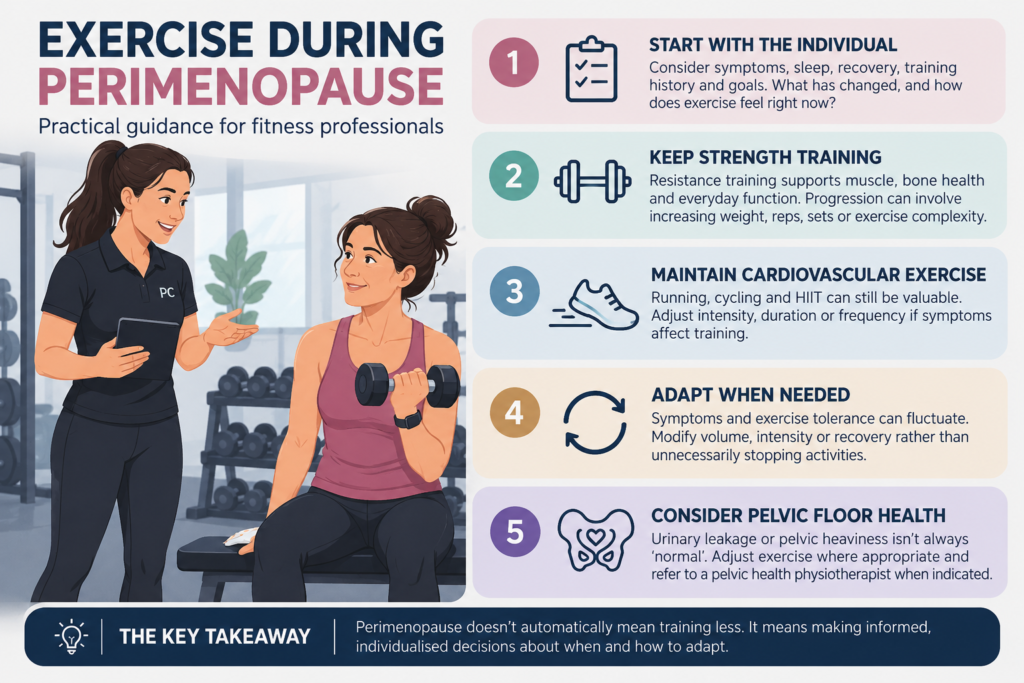
Resistance training remains important for maintaining strength, muscle and bone health.
As women age, preserving muscle mass and strength supports everyday function, while appropriately prescribed resistance and weight-bearing exercise can contribute to maintaining bone health.
Progressive overload involves gradually increasing training demands over time. This might mean increasing resistance, repetitions or sets, but progression doesn’t need to happen in every session.
Cardiovascular exercise also remains valuable for heart health, fitness and wellbeing.
Running, cycling and appropriately prescribed HIIT aren’t automatically unsuitable during perimenopause.
For some women, maintaining higher-intensity exercise is entirely appropriate. Others may benefit from temporarily adjusting intensity, duration or frequency when symptoms interfere with training.
The goal is appropriate exercise, not unnecessary restrictions.
In summary, you need to look at the individual needs and capacity, rather than banning a client from doing High-Intensity Interval Training or restricting heavy lifting loads, just because she is in perimenopause.
A Practical Coaching Example For Exercise During Perimenopause
Sarah, 46, has trained consistently for five years.
She enjoys three resistance sessions and two runs each week. Recently, she’s been sleeping poorly and feeling unusually tired.
A blanket approach might be to stop her running or replace her strength sessions with lighter workouts.
A better approach is to ask about changes in sleep, symptoms, training performance and how she feels during and after exercise before making adjustments.
For example, Sarah’s PT might temporarily reduce her resistance training volume while maintaining familiar exercises.
They could also replace one demanding run with an easier cardio session/ run, allowing more recovery between harder workouts.
Rather than removing exercise altogether, they monitor how Sarah responds and gradually restore training demands when appropriate.
If hot flushes are troublesome, a cooler training environment may also help.
These are examples of possible adjustments, not rules every woman should follow.
Modify what’s necessary. Maintain what’s beneficial.
Don’t Overlook Pelvic Floor Symptoms
Urinary leakage or pelvic heaviness during exercise shouldn’t simply be dismissed as normal.
These symptoms don’t automatically mean avoiding lifting, running or jumping.
Where symptoms occur, consider appropriate exercise adjustments and encourage assessment by a pelvic health physiotherapist, rather than simply advising someone to stop the activity.
Fitness professionals can adapt exercise, but they shouldn’t diagnose perimenopause or assume every symptom is hormone-related. New, persistent or concerning symptoms may require medical assessment.
What Should Fitness Professionals Remember About Exercise During Perimenopause?
Exercise during perimenopause shouldn’t follow a one-size-fits-all approach.
Effective coaching means understanding the individual’s symptoms, goals, exercise history and current capacity.
Perimenopause doesn’t automatically mean training less. It means making informed decisions about when and how to adapt.
Want to Understand Women’s Health Beyond the Basics?
Supporting women through perimenopause involves more than changing exercises. It requires an understanding of hormonal changes, symptoms, health considerations and individual exercise needs.
Parallel Coaching’s Level 3 Award in Understanding Women’s Health & The Menopause helps fitness professionals develop this knowledge and apply it to more informed coaching decisions.
Discover our Level 3 Women’s Health & Menopause Course → https://courses.parallelcoaching.co.uk/products/level-3-award-in-understanding-womens-health-and-the-menopause
Dedicated to More
Hayley “Exercise During Perimenopause: Should Women Train Differently?” Bergman
Parallel Coaching
P.S. You can also find us on the following platforms:
Instagram: Follow Parallel Coaching
Facebook: Join us on Facebook
YouTube: Watch Parallel Coaching on YouTube
More Blogs: Read our Women’s Health and Menopause blogs
Trustpilot: Read our learner reviews